The Dangers of Tarot: Limerence – Am I obsessed?
Have you ever noticed that you’re thinking about the same person all the time? Checking your phone more often than usual. Replaying conversations. Pulling tarot cards about them again and again. And at some point, you start wondering:
Is my interest still grounded in reality, or has it turned into something that’s no longer good for me?
If you use tarot regularly, this question can become even more complicated. Because your feelings are no longer just emotional. They are mixed with symbols, interpretations and “messages” that seem to confirm whatever you hope or fear is true.
This article is about that grey area between genuine feelings and emotional fixation – and about how tarot can sometimes intensify it.
What Is Limerence?
Limerence describes a state of strong emotional attachment to someone that becomes mentally consuming.
It often includes:
- Thinking about them most of the day
- Reading into every message or break in communication
- Feeling anxious when they don’t respond
- Imagining future scenarios constantly
- Depending on their attention for emotional stability
- Ignoring warning signs
- Feeling unable to let go
Limerence often feels good at first. The daydreaming about future scenarios and the endless possibilities feel invigorating. But as times goes on and the love interest naturally doesn’t act and behave the way we imagined, things start to go awry. For many people, the ongoing thoughts about the person – who is often completely clueless about the other person’s fixation – become a burden. The mind seems to be obsessed and unable to stop thinking about them. Limerence is usually less about the actual person and more about what they represent emotionally: validation, safety, hope or a sense of finally being chosen by someone.
How Tarot Can Reinforce Limerence
Tarot in general is not the problem. However, the way it’s used in emotionally vulnerable moments can be.
Pulling Cards Too Often
Many people start with good intentions. One reading turns into daily readings. Then into multiple readings a day. Often about the same person and the same questions. At that point, tarot stops being a source of guidance as the readings become convoluted and ultimately meaningless.
Searching for Confirmation
When you’re emotionally attached, you naturally look for signs that support what you want to believe. You start connecting random things to the connection. Certain cards, numbers, songs or “coincidences” suddenly feel meaningful. Tarot becomes a way to keep hope alive even when nothing concrete is happening.
Biased Interpretation
Strong feelings affect how you read.
Distance becomes “they’re scared.”
Silence becomes “they’re thinking about me.”
Mixed signals become “they’re confused but in love.”
Without noticing, you start protecting yourself from disappointment through interpretation.
Using Tarot to Regulate Emotions
Instead of sitting with uncertainty, you read.
Instead of feeling rejected, you read.
Instead of accepting reality, you read.
Tarot becomes a coping mechanism rather than a reflective tool.
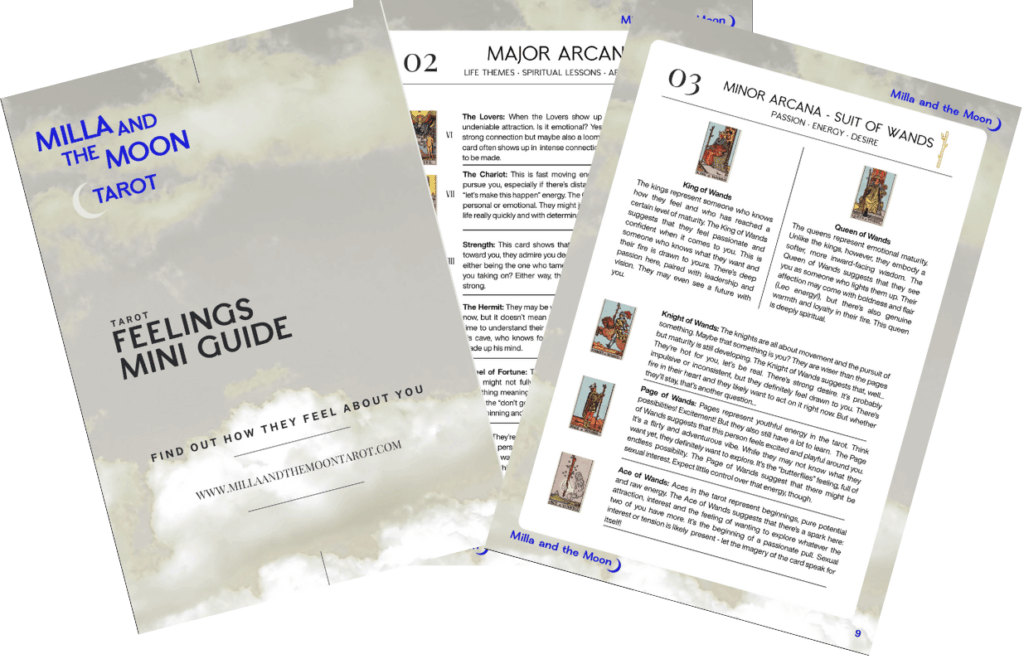
Or start here, with the free Mini Feelings Guide: