Three Swords cards in a row? A spread made up almost entirely of Major Arcana cards? If you’re familiar with tarot patterns, you likely already have a feeling for what the cards are trying to say!
And the good news is: you don’t have to be an expert to recognize these patterns. Basic structures like repeating suits, numbers or card groups are super easy to spot, even when you’re still learning!
In fact, understanding these patterns is one of the first things you can work with in tarot – long before you’ve memorized every individual card meaning.
Why Patterns are essential in Tarot
Patterns help you see the bigger picture in a spread instead of solely focusing on individual meanings.
When you read patterns, you start noticing things like:
- Which type of cards dominate the spread
- Which themes repeat
- Which numbers appear often
- Which suits are represented strongest
- Whether people or situations are emphasized
This allows you to understand the overall message quickly and naturally. For advanced tarot readers, understanding patterns is necessary to get everything out of a spread. A more advanced pattern, for example, is combining a card’s number with its position in a spread. The meaning of the card The Fool (number 0) becomes intensified when it appears in the beginning position of the spread. To quote Sandor Konraad:
“When The Fool appears at or near the beginning of a spread, he is truly a fool for he is about to embark upon an enterprise for which he has not properly prepared himself.”
For today’s learning, let’s focus on the following three patterns:
- Card Groups
- Suits
- And Numbers
Even a simple three-card spread becomes much clearer when you know what you’re looking for.
Pattern 1: The Three Main Groups in a Tarot Deck
Every tarot deck is divided into three main categories:
1. Major Arcana (22 Cards)
These are the “big picture” cards.
They often represent:
- Important life phases
- Psychological states
- Major lessons
- Deep inner changes
- Powerful influences
When many Major Arcana cards appear in a spread, it usually means something significant is happening. The situation is not just about everyday events — it touches something deeper. If the Majors are mostly positive, it often suggests emotional stability, growth, or strong personal agency. If they are challenging, it may point to inner conflicts or major life tests. These cards are often easier to read intuitively because their imagery is strong and expressive.
2. Minor Arcana (56 Cards)
The Minor Arcana deals with everyday life.
These cards describe:
- Daily situations
- Practical matters
- Emotions and reactions
- Short-term developments
- External circumstances
They show how things play out in real life.
The Minor Arcana is divided into four suits:
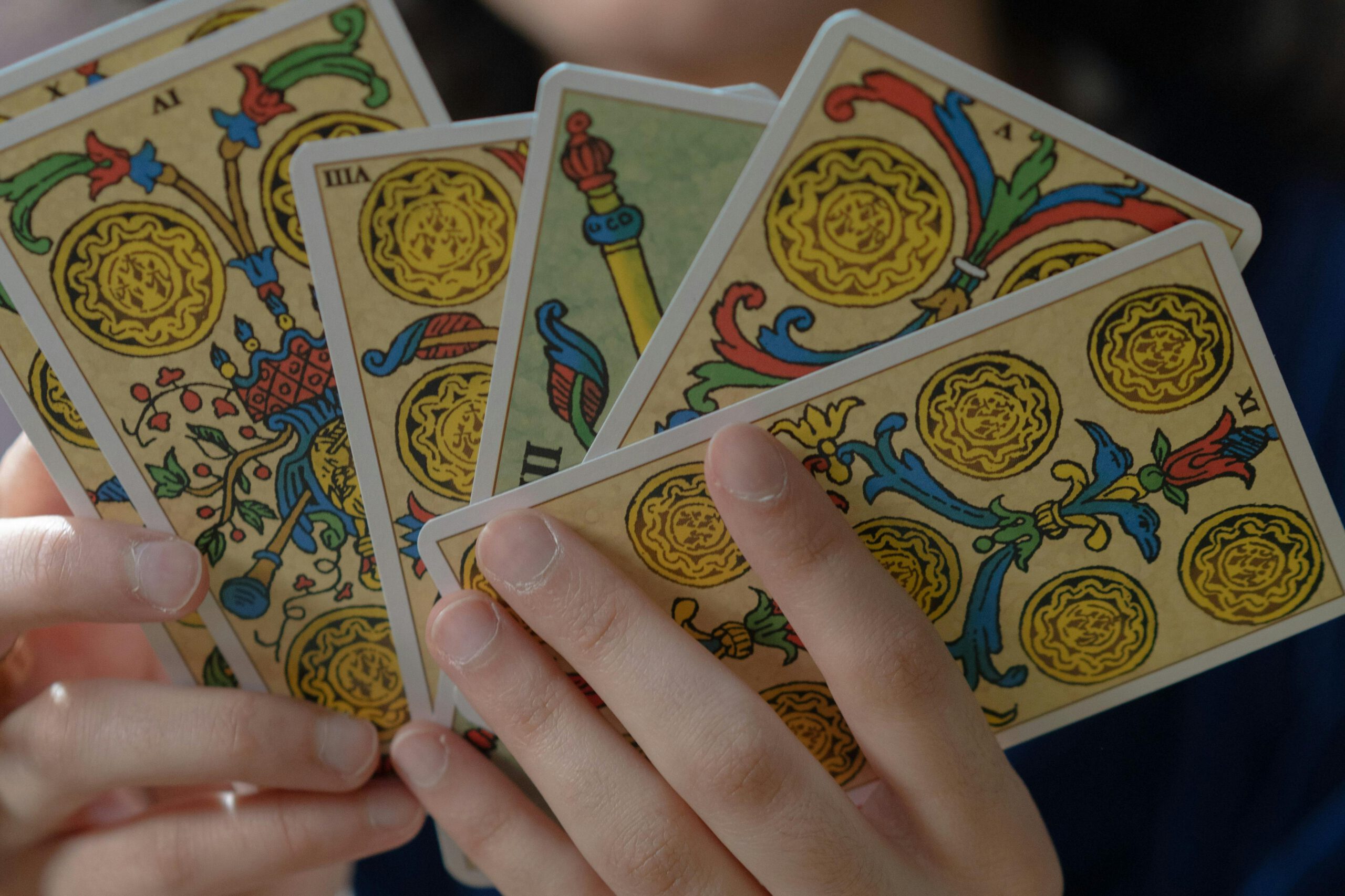
Coins (Pentacles)
Money, work, security, material life, health, business
Wands
Career, ambition, studies, creativity, motivation, projects
Cups
Love, emotions, relationships, family, friendships
Swords
mental activity, thoughts, conflicts, worries, stress, communication
If one suit dominates a reading, that area of life is especially important right now.
3. Court Cards (16 Cards – Part of the Minor Arcana)
Court Cards include:
- Kings
- Queens
- Knights
- Pages
They often represent people — or how someone is behaving.
In most readings, at least one Court Card appears, because many questions involve other people.
Here is a simple way to understand them:
- King → usually an adult man or strong masculine energy
- Queen → usually an adult woman or strong feminine energy
- Page → a child, young person, or beginner energy
- Knight → thoughts, attitudes, mental focus, or movement
Knights are special because they often represent mental states rather than specific people.
For example:
- Knight of Coins → thoughts about money or stability
- Knight of Wands → thoughts about career or goals
- Knight of Cups → romantic or emotional thoughts
- Knight of Swords → worried, angry, or restless thoughts
Reading by Suit: Finding the Main Theme
One of the fastest ways to understand a spread is to look at which suit appears most.
Ask yourself:
Are there many Cups?
→ Emotional or relationship focus
Are there many Wands?
→ Career, motivation, or creative focus
Are there many Coins?
→ Financial or practical focus
Are there many Swords?
→ Stress, conflict, or mental pressure
This immediately tells you what area of life is central to the situation.
The Power of Numbers in Tarot
Another important pattern is numerical symbolism.
Cards with the same number tend to share similar qualities, even across different suits.
If several cards with the same number appear, that theme is being emphasized.
Here is a simple overview of root numbers (1–9):
1 – Beginnings, Independence, Initiative
Leadership, starting something new, personal power
(Example: The Magician, Aces)
2 – Balance, Cooperation, Choice
Partnership, reflection, duality
3 – Growth, Creativity, Expansion
Expression, development, connection
4 – Stability, Structure, Security
Foundations, routines, boundaries
5 – Conflict, Change, Challenge
Disruption, tension, growth through difficulty
6 – Harmony, Relationships, Responsibility
Balance, care, mutual support
7 – Reflection, Testing, Inner Work
Evaluation, doubts, perseverance
8 – Power, Effort, Achievement
Control, discipline, progress
9 – Completion, Wisdom, Closure
Fulfillment, endings, preparation for change
When you combine number meanings with suit meanings, readings become much clearer.
Example:
Eight of Cups → emotional effort and withdrawal
Five of Wands → conflict in career or goals
Three of Coins → teamwork in work or business
Using Patterns for Quick Readings
If you only remember three things, remember these:
- Are there many Major or Minor cards?
- Which suit dominates?
- Which numbers repeat?
With just this, you can already give a coherent reading.
Example:
If a spread has:
- Mostly Major Arcana
- Many Cups
- Several 6s and 9s
You might read it as:
A deeply emotional life phase involving relationships and closure or healing.
You didn’t need to memorize every card to see that.
Pattern Reading While You’re Learning
You don’t have to choose between memorizing meanings and using patterns.
You can do both.
Many readers use pattern analysis while gradually learning individual cards. Over time, the two blend together naturally.
Patterns give you confidence early on. Card meanings add depth later.
A Simple Starting Point
If you feel overwhelmed by tarot, start here:
Learn:
- The four suits
- The three card groups
- Basic number meanings
Practice noticing patterns first. Let intuition and detail grow later.
Tarot is not about perfection. It’s about learning to read stories in symbols.
And patterns are the easiest way in.
What are their feelings? The Hierophant reversed
Here are some of the traditional interpretations of The Hierophant in love and relationships when it shows up reversed:
- they’re questioning traditional relationship models
- they want more freedom and flexibility
- they resist labels or expectations
- they feel restricted by commitment
- they’re redefining what love means to them
- they want to do things “their own way”
On a more challenging note, The Hierophant reversed can suggest:
- fear of commitment
- avoidance of responsibility
- rebellion against expectations
- confusion about long-term goals
- resistance to emotional structure
Are you dreading when reversed cards appear in a tarot reading? No need to worry – let me explain: First of all, did you know that many professional tarot readers choose to not work with reversed cards? Read my article about “Why I (almost) never read reversed cards” here. Moreover, read this article on “How To Read Reversed Tarot Cards” like a pro!
There is absolutely no right or wrong way of going about this, and including reversed cards in your readings can absolutely make sense. However, especially if you’re just starting out, know that many well established tarot professionals don’t feel the need to include them or assign special meaning to them.